
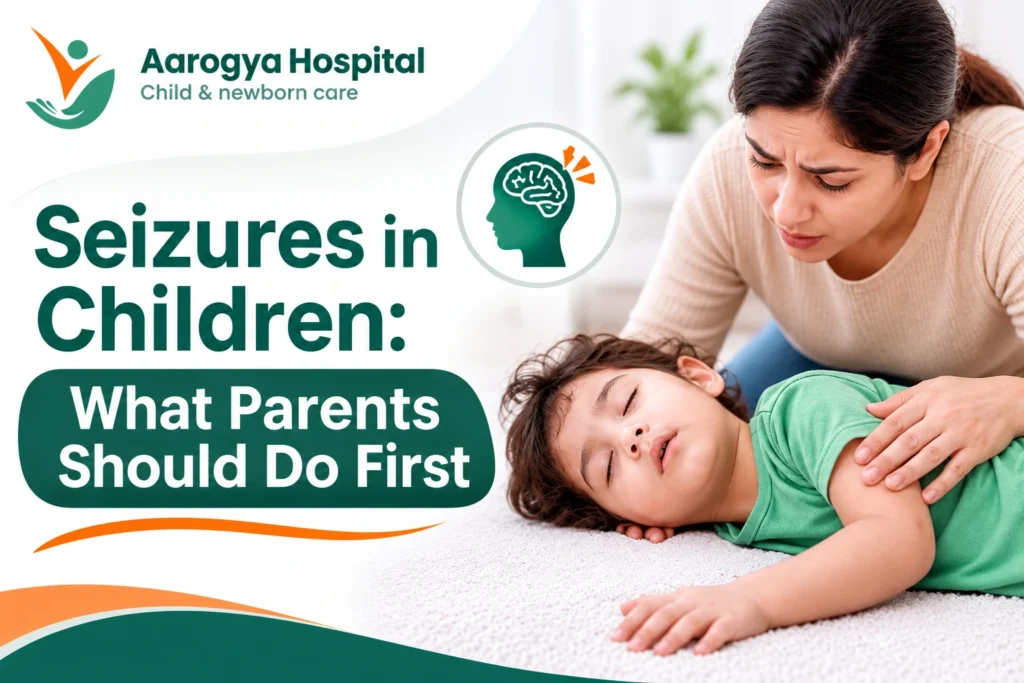
Seeing your child have a seizure is scary. Your child may shake, stare, or fall without warning. However, most seizures stop on their own within a few minutes. So, the first thing to do is stay calm. Then, follow the simple steps in this guide. At Aarogya Hospital in Chandigarh, we want every parent to know what to do in those first few moments.
What Is a Seizure in a Child?
A seizure is a short burst of unusual activity in the brain. As a result, a child may shake, stiffen, stare blankly, or lose awareness. Some seizures last only a few seconds. Others may go on for a few minutes.
Not every seizure looks the same. For example, some children jerk their arms and legs. Others simply stop, stare, and seem lost in thought. Also, many children feel sleepy or confused after the seizure ends.
Common Signs of a Seizure
Seizure signs can differ from child to child. Here are the signs parents see most often:
- Sudden shaking or jerking of the arms and legs
- A stiff body or a sudden fall
- Staring with no reply when you call
- Eyes rolling up or turning to one side
- Loss of bladder control
- Pale or blue lips
- Deep sleep or confusion right after
What Parents Should Do First
When a seizure starts, every second feels long. Therefore, a clear plan helps you act with confidence. Follow these steps in order:
- Stay calm and stay close. Your child needs you near. First, take a deep breath. Then, speak in a soft and steady voice.
- Note the time. Look at the clock as soon as the seizure begins. In addition, the exact time helps the doctor decide the next step.
- Clear the area. Move sharp, hard, or hot things away. Next, place something soft, such as a folded cloth, under the head.
- Turn your child on their side. This keeps the airway open. Moreover, it lets saliva or vomit drain out of the mouth.
- Loosen tight clothes. Open the collar and remove glasses. As a result, your child can breathe with ease.
- Watch and remember. Notice which body parts move and for how long. Later, share these details with the doctor.
- Stay until your child is fully awake. After the seizure, your child may feel tired or scared. So, hold them gently and talk softly until they wake up fully.
What Not to Do
Some common habits can cause harm. Therefore, please avoid the following:
- Do not put anything in your child’s mouth. A child cannot swallow the tongue, and fingers or spoons may cause injury.
- Do not hold your child down or try to stop the shaking.
- Not give water, food, or medicine by mouth until your child is fully awake.
- Do not splash water on the face or shake the child.
- Do not leave your child alone, even for a short time.
When to Call for Emergency Help
Most seizures end quickly. Still, some need urgent care. Call an ambulance (108 in India) or go to the nearest hospital right away if:
- The seizure lasts more than 5 minutes
- Another seizure starts before your child wakes up
- Your child has trouble breathing or the lips stay blue
- This is your child’s first seizure
- Your child hurt the head or body during the fall
- Child has a high fever with a stiff neck, rash, or repeated vomiting
- Your child does not wake up normally after the seizure
If you feel unsure, it is always safer to seek help. After all, a quick check can give you peace of mind.
Seizures With Fever (Febrile Seizures)
Some children have a seizure when they have a high fever. Doctors call this a febrile seizure. It is most common between 6 months and 5 years of age. Although it looks frightening, it is usually harmless and does not damage the brain. However, your child should still see a doctor. That way, the cause of the fever can be found and treated.
Common Causes of Seizures in Children
Seizures can happen for many reasons. For instance, doctors often find one of these causes:
- High fever
- Epilepsy
- Infections of the brain or its lining, such as meningitis
- Head injury
- Low blood sugar, low calcium, or low sodium
- Problems present from birth
Because the causes differ, each child needs a proper check-up.
How Doctors Find the Cause
After a seizure, the doctor will first ask about your child’s health and the event itself. Next, the doctor will examine your child. Depending on the case, tests may follow. These can include blood tests, an EEG (a test of brain waves), or a brain scan. Finally, the doctor will explain the results and suggest a treatment plan.
Tips for Parents at Home
Once your child is home, a few habits can keep them safe. In particular, these tips help:
- Keep a seizure diary with the date, time, length, and possible triggers.
- Give medicines on time and never stop them without your doctor’s advice.
- Make sure your child gets enough sleep.
- Supervise baths, swimming, and climbing.
- Tell teachers and caregivers what to do if a seizure happens.
Why Choose Aarogya Hospital, Chandigarh
If your child has had a seizure, please do not wait. Early care can bring clear answers and better peace of mind. At Aarogya Hospital in Chandigarh, our doctors listen to your concerns, examine your child with care, and explain each step in plain words. In addition, we support families from Chandigarh, Mohali, Panchkula, and nearby areas.
Worried about your child? Contact Aarogya Hospital, Chandigarh, today to book a consultation.
Conclusion
A seizure is a frightening moment for any parent. Yet, with the right steps, you can keep your child safe. To sum up, stay calm, note the time, turn your child on their side, and never put anything in the mouth. Finally, seek medical help and let a doctor find the cause.
Frequently Asked Questions
Is one seizure the same as epilepsy?
No. Epilepsy means a child has repeated seizures over time. Therefore, a single seizure does not always mean epilepsy.
Can a seizure harm my child's brain?
Short seizures rarely cause harm. However, a seizure that lasts more than 5 minutes needs urgent care.
Should I give my child water after a seizure?
No. Wait until your child is fully awake and alert. Otherwise, the water may go into the lungs.
Will my child have another seizure?
Some children do, while others never do. For this reason, a doctor’s check-up is the best way to know your child’s risk.
अक्सर पूछे जाने वाले सवाल
क्या एक बार दौरा पड़ने का मतलब मिर्गी (Epilepsy) है?
नहीं। मिर्गी का मतलब है कि बच्चे को बार-बार दौरे पड़ते हैं। इसलिए, एक बार दौरा पड़ने का मतलब हमेशा मिर्गी होना नहीं है।
क्या दौरे पड़ने से बच्चे के दिमाग को नुकसान हो सकता है?
छोटे समय तक रहने वाले दौरे से आमतौर पर दिमाग को नुकसान नहीं होता। लेकिन अगर दौरा 5 मिनट से ज्यादा समय तक रहे, तो तुरंत मेडिकल मदद लें।
क्या दौरा पड़ने के बाद बच्चे को पानी देना चाहिए?
नहीं। जब तक बच्चा पूरी तरह होश में न आ जाए, उसे पानी न दें। ऐसा करने से पानी फेफड़ों में जा सकता है।
क्या मेरे बच्चे को दोबारा दौरा पड़ सकता है?
कुछ बच्चों को दोबारा दौरा पड़ सकता है, जबकि कुछ बच्चों को कभी दोबारा दौरा नहीं पड़ता। इसलिए, बच्चे की सही जांच और सलाह के लिए डॉक्टर से मिलना जरूरी है।