
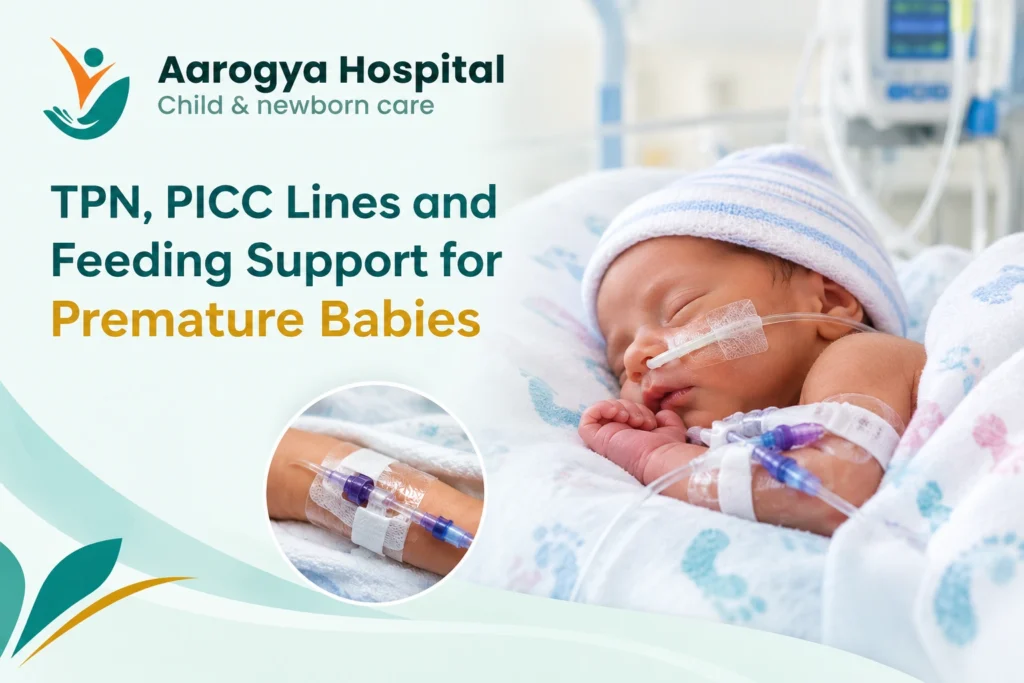
TPN, PICC Lines and Feeding Support for Premature Babies
Introduction
Premature babies are born before 37 weeks of pregnancy. Their bodies are still growing. Therefore, they may need extra help with feeding and nutrition.
Some premature babies cannot drink enough milk. Others have trouble digesting milk or need special medical care. In such cases, doctors may suggest TPN, a PICC line, or tube feeding.
These treatments help babies get the nutrients they need to grow and stay healthy. However, every baby is different. Doctors choose the best feeding method based on the baby’s health, weight, and growth.
At Aarogya Hospital, Chandigarh, parents can ask about premature baby care, newborn feeding, and NICU services.
Why Do Premature Babies Need Special Feeding Support?
Premature babies may have trouble feeding because their bodies are not fully develop. They may also find it hard to suck, swallow, and breathe at the same time.
As a result, some babies need extra help to get enough nutrition.
Common reasons include:
- Poor sucking and swallowing: The baby may not be ready to drink milk safely.
- Low birth weight: The baby needs enough nutrients to grow.
- Immature digestion: The baby’s stomach and intestines may need more time to develop.
- Breathing problems: Babies who need help with breathing may also need feeding support.
- Serious illness: Some babies need extra nutrition while they recover.
- Higher nutritional needs: Premature babies need enough energy, protein, vitamins, and minerals to grow.
Meanwhile, the neonatologist, a doctor who specialises in newborn care, assesses the baby’s health and plans the most suitable feeding method.
What Is TPN (Total Parenteral Nutrition)?
TPN stands for Total Parenteral Nutrition. In other words, it is a method of delivering nutrients directly into a baby’s bloodstream through an IV line.
Doctors may use TPN when a premature baby cannot get enough nutrition through milk.
TPN contains important nutrients, such as:
- Glucose: Gives the baby energy.
- Amino acids: Help the body grow and repair itself.
- Fats: Provide energy and support healthy growth.
- Vitamins and minerals: Help the body work properly.
- Electrolytes: Help maintain the right balance of fluids and minerals.
Doctors adjust the TPN mixture according to the baby’s weight, age, blood tests, and nutritional needs.
When Does a Premature Baby Need TPN?
Doctors may suggest TPN when:
- The baby is born very early.
- Baby has a very low birth weight.
- The baby cannot take enough milk.
- The baby has certain stomach or intestinal problems.
- Recovering from a serious illness.
- Safely receive enough milk for medical reasons.
Some babies can receive small amounts of milk while also getting TPN.
As the baby starts taking more milk, doctors may slowly reduce TPN when it is safe to do so.
How Do Doctors Monitor TPN?
TPN needs careful monitoring because a premature baby’s needs can change quickly.
Doctors and nurses may check:
- Blood sugar levels.
- Blood tests for salts and minerals.
- Fluid intake and urine output.
- Weight gain and growth.
- Liver health when needed.
- Signs of infection or problems with the IV line.
As a result, these checks help the medical team provide the right amount of nutrition and identify any problems early.
What Is a PICC Line in a Premature Baby?
A PICC line is a thin, soft tube place into a vein, usually in the baby’s arm or leg.
A PICC stands for Peripherally Inserted Central Catheter. In this procedure, a thin tube is insert through a vein and guide into a larger vein near the heart. Doctors check its position before using it.
Additionally, a PICC line can be use to deliver TPN, certain medicines, and other essential treatments directly into the bloodstream.
Why Might a Premature Baby Need a PICC Line?
Doctors may suggest a PICC line when a baby needs IV nutrition or medicines for several days or longer.
A PICC line can:
- Provide steady access to a vein.
- Allow doctors to give certain strong nutrition solutions.
- Reduce the need for repeated short-term IV lines.
- Help the medical team continue treatment in the NICU.
However, not every premature baby needs a PICC line. Some babies can receive treatment through a regular IV line.
How Is a PICC Line Care For?
A PICC line needs careful handling to reduce the risk of infection and other problems.
Doctors and nurses may:
- Keep the area clean and covered.
- Check the skin around the line.
- Use clean, sterile methods when handling the line.
- Look for redness, swelling, or fluid leakage.
- Check the line’s position when needed.
Parents should never touch, flush, adjust, or remove the line themselves.
Tell the nurse or doctor immediately if you notice any unusual changes around the line.
What Is Feeding Support for Premature Babies?
Feeding support helps premature babies get enough nutrition while they grow.
Therefore, doctors choose the most suitable feeding method based on the baby’s age, breathing, digestion, and ability to swallow safely.
The main feeding methods include breast milk, tube feeding, and feeding by mouth.
1. Breast Milk Feeding
Mother’s breast milk is usually the first choice for premature babies when it is available and suitable.
It provides important nutrients that help the baby grow. It also contains substances that help protect the baby from some infections.
Additionally, some premature babies need fortified breast milk. This means extra nutrients are add to provide more protein, minerals, and calories to support healthy growth.
Additionally, if the mother’s milk is not available, donor breast milk may be considered where it is available and suitable for the baby. Doctors may also suggest special formula made for premature babies.
2. Tube Feeding
Some premature babies are too young or weak to drink milk safely.
In such cases, doctors may suggest tube feeding.
A thin tube is pass through the baby’s nose or mouth into the stomach. Milk is then give through the tube in small, measure amounts.
Tube feeding helps babies get enough nutrition while they develop their feeding skills.
Doctors and nurses check how well the baby handles the milk. They also watch for vomiting, tummy swelling, and poor weight gain.
3. Moving to Breastfeeding or Bottle Feeding
As the baby grows stronger, the medical team checks when it is safe to start feeding by mouth.
The change happens slowly. It depends on the baby’s breathing, swallowing skills, and ability to take milk safely.
Parents may receive help with:
- Breastfeeding.
- Expressing breast milk.
- Recognising when the baby is ready to feed.
- Understanding the baby’s feeding needs.
Every baby develops at a different speed. Some babies start feeding by mouth early, while others need more time.
TPN vs PICC Line vs Tube Feeding: What Is the Difference?
These methods have different uses in premature baby care.
Treatment | Main purpose |
TPN | Gives nutrients directly into the bloodstream. |
PICC line | Provides access to a vein for TPN, certain medicines, and other treatments. |
Tube feeding | Gives milk directly into the stomach through a thin tube. |
Breastfeeding or bottle feeding | Gives milk by mouth when the baby can feed safely. |
A PICC line is not a type of nutrition. Instead, it is a tube that doctors may use to give TPN.
Tube feeding uses the baby’s stomach and intestines to digest milk. TPN gives nutrients directly into the bloodstream.
Some premature babies may need more than one feeding method at the same time.
What Are the Possible Risks?
These treatments help babies get the nutrition they need. However, some risks are possible.
Possible risks of TPN include:
- Changes in blood sugar levels.
- Changes in salt and mineral levels.
- Fluid balance problems.
- Liver problems, especially with long-term use.
- Infection related to the IV line.
Possible risks of a PICC line include:
- Infection in the bloodstream.
- Blood clots.
- A blocked or moved line.
- Damage or irritation to the vein.
Possible risks of tube feeding include:
- A blocked or moved feeding tube.
- Vomiting or trouble handling milk.
- Milk entering the airway if feeding is not manage properly.
- Serious bowel problems in some vulnerable premature babies.
Meanwhile, the medical team closely monitors the baby and takes steps to reduce these risks.
How Long Does a Premature Baby Need Feeding Support?
The time needed depends on the baby’s health and growth.
Some babies need TPN for only a short time. Others may need it for longer because they were born very early or have other health problems.
A PICC line stays in place only while it is need and safe. Tube feeding may continue until the baby can drink enough milk by mouth.
Doctors consider:
- The baby’s birth age and weight.
- Breathing and overall health.
- How well the baby handles milk.
- Weight gain and growth.
- Blood test results.
- The ability to suck, swallow, and breathe safely.
The goal is to give the baby enough nutrition and move towards full milk feeding when possible.
How Can Parents Help a Premature Baby During Feeding Treatment?
Parents play an important role in their baby’s care and growth.
Here are some ways to help:
- Provide breast milk when possible: Ask the medical team how to express and store breast milk safely.
- Follow feeding instructions: Give milk only as advised by the doctor.
- Practise kangaroo mother care: Skin-to-skin contact may help with bonding, body temperature, and breastfeeding when medically safe.
- Learn feeding signs: Ask the medical team how to recognise when the baby is hungry, tire, or uncomfortable.
- Attend follow-up visits: Regular check-ups help doctors track the baby’s growth.
- Ask questions: Understand why your baby needs TPN, a PICC line, or tube feeding.
Never change the feeding amount or stop prescribed nutrition without medical advice.
When Should Parents Seek Immediate Medical Attention?
Premature babies can become seriously ill quickly. Contact the medical team immediately if your baby has:
- Difficulty breathing or pauses in breathing.
- Blue or grey lips or skin.
- Unusual sleepiness or difficulty waking.
- Repeated vomiting, especially green vomit.
- A swollen or unusually firm tummy.
- A sudden change in feeding or activity.
- Redness, swelling, bleeding, or leakage around a PICC line.
Fever or an unusually low body temperature can also be a warning sign in a newborn.
Seek urgent medical care without waiting for other symptoms. However, if your baby has been discharge, contact the neonatal team or seek emergency care, depending on your baby’s condition.
Premature Baby Feeding Support at Aarogya Hospital, Chandigarh
Premature babies may need extra nutrition while their bodies grow. The right feeding plan and regular checks help doctors meet their needs.
At Aarogya Hospital, Chandigarh, parents can ask about premature baby care, NICU services, newborn nutrition, and assessment by a neonatal specialist.
The right treatment depends on each baby’s condition. Therefore, please confirm directly with the hospital whether TPN, PICC line placement, tube feeding, and other specialised services are available.
Worried about your premature baby’s feeding or growth? Contact Aarogya Hospital to discuss your baby’s needs and the care options available.
Conclusion
TPN, PICC lines, and tube feeding help premature babies who need extra nutritional support.
Each method has a different purpose. For example, TPN provides nutrients through a vein, a PICC line provides access to a vein, and tube feeding delivers milk directly into the stomach.
Doctors choose the right method based on the baby’s health, feeding ability, and growth.
With proper care and regular monitoring, premature babies can gradually move towards full milk feeding when they are ready.
For advice about premature baby nutrition and newborn care, contact Aarogya Hospital, Chandigarh. This way, you can discuss the services available for your baby.
Follow up Instagram and Facebook for more information.
Frequently Asked Questions (FAQs)
What is TPN for premature babies?
TPN gives nutrients directly into a baby’s bloodstream. Doctors may use it when a premature baby cannot get enough nutrition through milk.
Why do premature babies need a PICC line?
A PICC line gives doctors access to a larger vein. They may use it to give TPN and certain medicines. It can also reduce the need for repeated short-term IV lines.
Can a premature baby receive breast milk while on TPN?
Yes. If the baby’s condition allows, doctors may give small amounts of breast milk along with TPN. Furthermore, milk feeds are gradually increase as the baby grows and tolerates them well.
Is tube feeding safe for premature babies?
Tube feeding is commonly use when premature babies cannot drink milk safely. Trained healthcare professionals monitor the baby and adjust feeding as needed.
Does every premature baby need TPN?
No. Many premature babies get enough nutrition through breast milk, fortified milk, special formula, or tube feeding. TPN is use when nutrition through the stomach is not enough or is not suitable.
How long does a PICC line stay in a premature baby?
There is no fixed time. The line stays in place only while it is need and safe. Doctors check it regularly and remove it when it is no longer require.
Which milk is best for premature babies?
Mother’s breast milk is usually prefer when available and suitable. Additionally, some babies may need fortified breast milk, donor breast milk, or special formula designed for premature babies.
How can parents help a premature baby gain weight?
Follow the doctor’s feeding plan, provide breast milk when possible, and attend regular check-ups. Kangaroo mother care may also help when recommended by the medical team.