
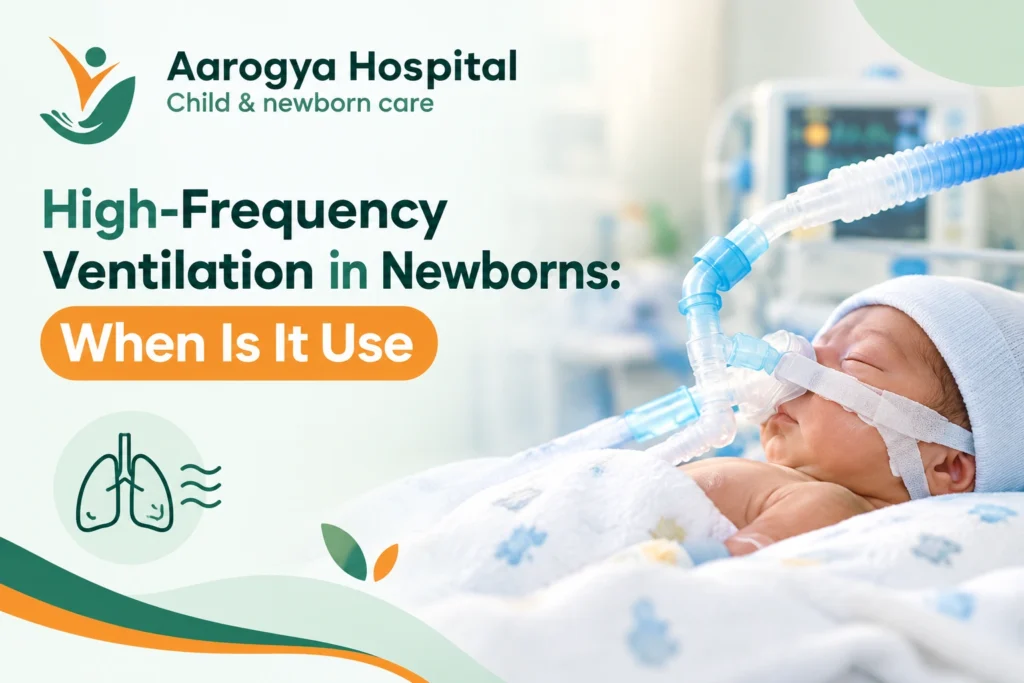
High-Frequency Ventilation in Newborns: When Is It Use?
When a newborn has difficulty breathing, doctors may provide breathing support. Some babies improve with simple treatment, while others need advanced care.
High-frequency ventilation is one type of breathing support for newborns. It uses a special machine to help babies with serious lung problems breathe.
Doctors may use this treatment when a regular ventilator does not help enough. It may also help reduce the risk of lung damage in some cases.
At Aarogya Hospital, Chandigarh, parents can talk to the medical team about their newborn’s breathing problems and possible treatments.
What Is High-Frequency Ventilation in Newborns?
High-frequency ventilation (HFV) is a special type of breathing support. It uses a machine to send tiny amounts of air or gas through a breathing tube very quickly.
A regular ventilator gives bigger breaths more slowly. However, high-frequency ventilation gives tiny breaths or quick pressure changes many times every second.
This method helps doctors control oxygen levels and remove carbon dioxide from the baby’s body. It may also help prevent the lungs from stretching too much in some cases.
Doctors decide if a baby needs this treatment by checking their health, age, weight, lung condition, and response to other treatments.
When Is High-Frequency Ventilation Use in Newborns?
Doctors may use high-frequency ventilation when a newborn has severe breathing problems and needs extra breathing support.
1. Severe Respiratory Distress Syndrome
Respiratory distress syndrome (RDS) is a breathing problem that often affects premature babies. Their lungs may not be fully develop, making it hard for them to breathe normally.
These babies may struggle to keep their lungs open and maintain healthy oxygen levels.If a regular ventilator does not help enough, doctors may use high-frequency ventilation in some cases.
2. Persistent Pulmonary Hypertension of the Newborn (PPHN)
PPHN is a condition in which the blood vessels in a newborn’s lungs stay too narrow after birth. As a result, the blood cannot get enough oxygen.
Doctors check the baby’s oxygen levels, lung health, and response to treatment. They may use high-frequency ventilation if it is right for the baby’s condition.
Some babies may also need medicines like inhaled nitric oxide to help blood flow more easily through the lungs.
3. Air Leak in the Lungs
Sometimes, air leaks out of the lungs into the space around them. This is an air leak. Pneumothorax is one type of air leak.
An air leak can make breathing difficult and may require urgent treatment.
In some cases, doctors may use high-frequency ventilation to help the baby breathe with smaller breaths. The treatment depends on the type of air leak and the baby’s condition.
4. Severe Meconium Aspiration Syndrome
Sometimes, a baby breathes in fluid containing meconium (the baby’s first stool) before or during birth. This can block or irritate the airways and make breathing difficult.
This condition is meconium aspiration syndrome.
Some babies need a ventilator to help them breathe. If the problem is severe, doctors may use high-frequency ventilation depending on the baby’s condition and response to a regular ventilator.
5. Severe or Ongoing Breathing Problems
Some newborns still have low oxygen levels or trouble removing carbon dioxide, even when using a regular ventilator.
In these cases, doctors review the baby’s condition and may change the type of breathing support.
High-frequency ventilation is one possible treatment. However, not every baby needs it or can benefit from it.
What Are the Types of High-Frequency Ventilation?
Doctors may use different types of high-frequency ventilation based on the baby’s condition and the equipment available.
High-Frequency Oscillatory Ventilation (HFOV)
HFOV uses tiny, rapid movements of air to help the baby get oxygen and remove carbon dioxide. Doctors may use it for newborns with serious lung problems.
High-Frequency Jet Ventilation (HFJV)
HFJV sends tiny bursts of gas through a special breathing machine. Doctors may use it for certain breathing problems, including some cases where air leaks from the lungs.
The neonatal team chooses the most suitable method based on the baby’s needs and the team’s expertise.
How Does High-Frequency Ventilation Help a Newborn?
High-frequency ventilation helps doctors support breathing in seriously ill newborns.
Its possible benefits include:
- Helping maintain healthy oxygen levels.
- Helping remove carbon dioxide from the body.
- Supporting babies with certain serious lung conditions.
- Using very small breaths to limit lung stretching in suitable cases.
However, this treatment also has some risks. Its benefits depend on the baby’s health and how the machine is adjust.
High-frequency ventilation does not guarantee recovery. It is also not always better than a regular ventilator.
Is High-Frequency Ventilation Safe for Newborns?
High-frequency ventilation is use in newborn intensive care. However, a trained medical team must monitor the baby closely during treatment.
Possible risks include changes in blood pressure, reduced blood flow to the lungs due to incorrect settings, air leaks, and problems with the breathing tube.
Premature babies and babies with serious illnesses may also face risks from their underlying conditions.
Doctors closely monitor the baby’s:
- Oxygen levels.
- Carbon dioxide levels through blood tests.
- Blood pressure and heart rate.
- Chest movement and breathing.
- Overall response to treatment.
Doctors may also use chest X-rays or other tests when needed.
The medical team adjusts the ventilator based on the baby’s condition. They may change the breathing support when it is safe.
How Long Does a Newborn Need High-Frequency Ventilation?
High-frequency ventilation does not have a fixed duration. Some babies need it for a short time, while others may need it for longer.
The duration depends on several factors:
- The cause and severity of the breathing problem.
- The baby’s age at birth and overall health.
- The amount of oxygen the baby needs.
- Blood test results.
- How well the baby responds to treatment.
- Whether other medical problems are present.
As the baby’s lungs improve, doctors may slowly reduce the breathing support.
Doctors may then switch the baby to a regular ventilator, CPAP, or another suitable breathing support method.
What Is the Difference Between HFOV and Conventional Ventilation?
Both methods help babies breathe, but they work in different ways.
Feature | Conventional Ventilation | High-Frequency Ventilation |
Breathing pattern | Larger breaths at a slower rate | Very small breaths or rapid pressure changes |
Main purpose | Supports breathing and gas exchange | Provides specialise support in select cases |
When it is use | Commonly use when a baby needs a ventilator | Consider for certain serious breathing problems |
Monitoring | Requires close medical monitoring | Requires close monitoring and specialise skills |
Neither method is best for every baby. Doctors choose the most suitable option based on the baby’s condition and response to treatment.
What Should Parents Know About High-Frequency Ventilation?
Seeing a newborn on a breathing machine can be scary for parents. However, the machine helps the medical team support the baby’s breathing while treating the cause of the problem.
Parents can ask the treating doctor these questions:
- Why does my baby need this type of breathing support?
- What are the possible benefits and risks for my baby?
- How will you check whether the treatment is working?
- What signs will show that my baby is improving?
- When might you reduce or change the breathing support?
The treating doctor can explain the baby’s condition and share updates about the treatment.
Newborn Respiratory Support at Aarogya Hospital, Chandigarh
Newborns with serious breathing problems need prompt medical assessment, careful monitoring, and special breathing support.
The right treatment depends on the cause of the problem and the baby’s condition.
You can contact Aarogya Hospital, Chandigarh, to learn about newborn care and available services. Please confirm directly with the hospital whether high-frequency ventilation and specialist newborn care are available.
Seek urgent medical care if your newborn breathes quickly or struggles to breathe, makes grunting sounds, has a chest that pulls inward with each breath, or develops bluish or grey skin. Do not wait for these signs to improve on their own.
Conclusion
High-frequency ventilation can help some newborns with serious breathing problems. It supports breathing by delivering very small breaths or rapid pressure changes.
However, not every baby needs this treatment. Doctors assess each baby carefully and monitor their response to the ventilator.
Early medical care and the right breathing support can help doctors treat serious breathing problems. If you are worry about your newborn’s breathing, seek medical advice from a qualified healthcare professional immediately.
Frequently Asked Questions
What is high-frequency ventilation in newborns?
High-frequency ventilation is a special type of breathing support. It uses tiny breaths or quick pressure changes to help newborns with serious breathing problems.
Is high-frequency ventilation use for premature babies?
Yes. Doctors may use it for premature babies with serious lung problems, such as respiratory distress syndrome, when this treatment is right for them.
Is HFOV the same as a regular ventilator?
No. A regular ventilator gives bigger breaths more slowly, while HFOV uses tiny, rapid pressure changes to help the baby breathe. Both need close medical monitoring.
How long can a newborn stay on high-frequency ventilation?
The time needed varies for each baby. It depends on the lung condition, oxygen levels, blood test results, and response to treatment. Doctors decide when to reduce or change the breathing support.
Does every newborn with breathing problems need high-frequency ventilation?
No. Many newborns improve with simpler breathing support, such as oxygen, CPAP, or a regular ventilator. Doctors use high-frequency ventilation only when it is suitable for the baby’s condition.