
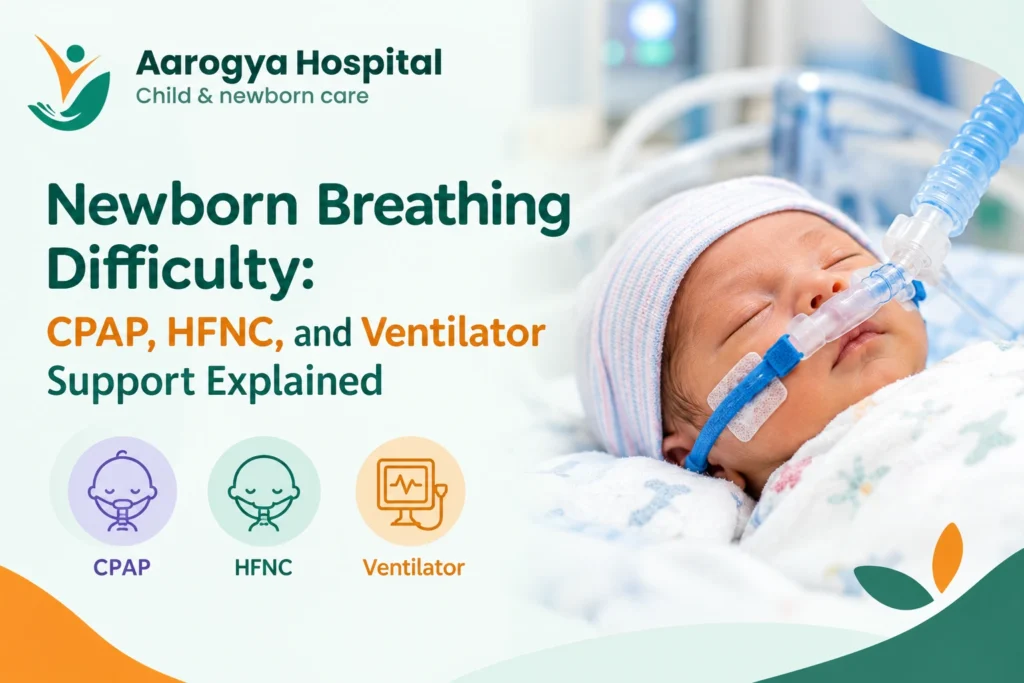
Newborn Breathing Difficulty: CPAP, HFNC and Ventilator Support Explained
Newborn babies may sometimes have trouble breathing, especially if they are born early. Their lungs may not be fully developed yet. As a result, they may need extra help to breathe after birth. In such cases, doctors may provide breathing support to help the baby get enough oxygen.
At Aarogya Hospital Chandigarh, knowing the causes of newborn breathing problems and the available treatments can help parents understand their baby’s care. Depending on the baby’s condition, doctors may use CPAP, HFNC, or a ventilator to help the baby breathe.
What Causes Breathing Difficulty in Newborn Babies?
Breathing problems can develop shortly after birth or during the first few days of life. Some common causes include:
- Premature birth: A premature baby’s lungs may not produce enough surfactant, a substance that helps keep the air sacs open.
- Respiratory distress syndrome (RDS): This condition occurs when a baby’s lungs are not mature enough to work properly.
- Transient tachypnoea of the newborn (TTN): Extra fluid in the lungs can cause fast breathing after birth.
- Infections: Conditions such as pneumonia or newborn sepsis may affect breathing.
- Meconium aspiration: A baby may breathe in meconium-stained fluid before or during birth.
- Other medical conditions: Some heart or lung problems can also cause breathing difficulties.
Newborn breathing problems can become serious very quickly. Therefore, early medical check-ups are important to help doctors find the cause and provide the right treatment on time.
Signs of Breathing Difficulty in Newborns
Parents and caregivers should look for these warning signs:
- Fast or difficult breathing
- Grunting sounds with each breath
- Nostrils widening while breathing
- Skin pulling in around the ribs or below the chest
- Bluish or grey lips, tongue, or skin
- Pauses in breathing
- Difficulty feeding because of breathing problems
- Unusual sleepiness or reduced responsiveness
Get emergency medical help immediately if your newborn has blue or grey lips, struggles to breathe, repeatedly stops breathing, or does not respond. Do not wait for these signs to go away on their own.
What Is CPAP for Newborn Babies?
CPAP stands for Continuous Positive Airway Pressure. It gently pushes air through small nasal tubes or a mask to help keep the baby’s airways open. Doctors can adjust the oxygen level according to the baby’s needs.
CPAP helps keep a baby’s airways and tiny air sacs in the lungs open. This makes breathing easier and reduces the effort needed to breathe.
When Is CPAP Use?
Doctors may recommend CPAP for babies who:
- Have respiratory distress but can breathe on their own.
- Are born prematurely and need help keeping their lungs open.
- Have certain types of respiratory distress syndrome.
- Need additional breathing support after birth.
CPAP does not breathe completely for the baby. Instead, it supports the baby’s own breathing.
What Is HFNC for Newborn Babies?
HFNC stands for High-Flow Nasal Cannula. It delivers warm, moist air or a mix of air and oxygen through small tubes placed in the baby’s nose. This helps support the baby’s breathing.
HFNC helps babies breathe more comfortably and reduces the effort needed to breathe. It may also help keep the airways open, but its effect is less reliable than CPAP.
When Is HFNC Use?
Doctors may use HFNC for some newborns who need help breathing. The choice depends on the baby’s age, health problem, and overall condition.
It may be use for:
- Mild to moderate breathing difficulties in suitable babies.
- Some babies who are being step down from stronger respiratory support.
- Selected cases where a less intrusive breathing support method is appropriate.
However, HFNC is not right for every newborn. Some premature babies may need CPAP first, especially if they have a higher risk of breathing problems. Doctors will closely monitor the baby and change the treatment if needed.
What Is a Ventilator for Newborn Babies?
A mechanical ventilator is a machine that helps a baby breathe when they cannot breathe well enough on their own.
Depending on the baby’s condition, doctors may place a breathing tube into the windpipe. The ventilator then helps the baby breathe by giving controlled breaths or supporting their own breathing. Some special breathing methods can also help without using a breathing tube.
When Does a Newborn Need Ventilator Support?
Doctors may recommend mechanical ventilation when a baby:
- Has severe respiratory distress.
- Cannot maintain adequate oxygen or carbon dioxide levels.
- Has repeated or prolonged pauses in breathing.
- Has severe lung disease or certain complications of prematurity.
- Needs breathing support during critical illness.
A neonatal care team closely monitors babies who need a ventilator. Doctors adjust the machine’s settings based on the baby’s breathing, oxygen levels, blood test results, and overall health.
CPAP vs HFNC vs Ventilator: What Is the Difference?
Although all three methods support breathing, they work differently.
Feature | CPAP | HFNC | Mechanical Ventilator |
Main purpose | Keeps airways and air sacs open | Delivers warmed, humidified high-flow gas | Provides or assists breaths |
How it is deliver | Usually through nasal prongs or a mask | Through small nasal tubes | Often through a breathing tube in the windpipe |
Baby’s own breathing | Baby breathes independently | Baby breathes independently | Machine assists or controls breathing as needed |
Typical use | Respiratory distress requiring continuous pressure | Selected babies needing non-invasive support | Severe breathing problems or inadequate ventilation |
Monitoring | Close neonatal monitoring | Close neonatal monitoring | Intensive monitoring and adjustment |
Important: No single breathing support method is right for every newborn. Doctors choose the best option based on how early the baby was born, the breathing problem, oxygen needs, breathing effort, and response to treatment.
How Do Doctors Decide Which Breathing Support a Baby Needs?
The neonatal team assesses several factors before choosing a treatment.
1. Breathing Rate and Effort
Doctors check the baby’s breathing rate and look for signs of breathing difficulty, such as the chest pulling inward or grunting sounds.
2. Oxygen Levels
A pulse oximeter checks the baby’s oxygen levels. Doctors may also do blood tests to check oxygen and carbon dioxide levels in the blood.
3. Gestational Age and Birth Weight
Premature and low-birth-weight babies may have less mature lungs and need specialised support.
4. The Underlying Cause
Treatment depends on what is causing the breathing problem, such as being born early, an infection, fluid in the lungs, or another health condition.
5. Response to Treatment
Treatment depends on what is causing the breathing problem, such as being born early, an infection, fluid in the lungs, or another health condition.
How Long Does a Newborn Need Breathing Support?
There is no set time for how long a baby needs CPAP, HFNC, or a ventilator. Some babies need breathing support for a short time, while others may need it for several days or longer.
How long a baby needs breathing support depends on how developed their lungs are, how serious their illness is, whether they have an infection, and how quickly they improve with treatment.
Doctors slowly reduce breathing support when the baby breathes more easily and needs less oxygen. Every baby recovers at their own pace, so the time needed for recovery can be different.
What Is the Role of the NICU in Newborn Breathing Problems?
A Neonatal Intensive Care Unit (NICU) is a special unit that cares for newborn babies who need close monitoring or extra medical support.
Depending on the hospital’s facilities and the baby’s condition, NICU care may include:
- Continuous monitoring of heart rate, breathing, and oxygen levels.
- CPAP, HFNC, or mechanical ventilation when clinically indicated.
- Temperature control and feeding support.
- Medicines and other treatments for the underlying cause.
- Regular assessment by trained neonatal clinicians.
At Aarogya Hospital Chandigarh, parents can talk to the medical team about newborn care, breathing support, and referral options. The right care depends on the baby’s condition and the facilities available.
Conclusion
Breathing problems in newborns can worry parents. However, early medical care and the right breathing support can help many babies recover. CPAP helps keep the lungs open, HFNC delivers warm, moist air or an air-and-oxygen mixture, and a ventilator helps the baby breathe when more support is needed.
If your newborn has trouble breathing, seek medical help immediately. Early assessment by a qualified neonatal team can help find the cause and decide on the right treatment for your baby.
Aarogya Hospital Chandigarh
For information about newborn care and available respiratory support, contact the hospital and discuss your baby’s needs with the treating medical team.
Frequently Asked Questions
Is CPAP safer than a ventilator for newborns?
CPAP is less invasive because it usually does not require a breathing tube. However, it is not appropriate for every baby. A ventilator may be necessary when a baby cannot breathe effectively or needs more advanced support. Doctors choose the safest suitable method for each baby.
Is HFNC better than CPAP for premature babies?
Not always. HFNC may be suitable for select newborns, but CPAP is often prefer as initial non-invasive support for very premature babies or babies at higher risk of respiratory distress syndrome. The decision depends on the baby’s condition and the neonatal team’s assessment.Lorem ipsum dolor sit amet, consectetur adipiscing elit. Ut elit tellus, luctus nec ullamcorper mattis, pulvinar dapibus leo.
Does needing a ventilator mean a newborn is in danger?
A ventilator is use when a baby needs significant breathing support. It indicates that the baby requires close medical care, but it does not automatically mean the outcome will be poor. Recovery depends on the underlying condition, its severity, and the baby’s response to treatment.
Can a baby feed while receiving CPAP or HFNC?
Feeding depends on the baby’s breathing stability, support settings, and ability to swallow safely. Some babies may receive breast milk through a feeding tube until oral feeding is safe. The neonatal team will guide parents on expressing breast milk and starting feeds.
When should parents seek emergency help for newborn breathing difficulty?
Seek immediate medical attention if a newborn has severe breathing difficulty, blue or grey lips or tongue, repeated pauses in breathing, or reduced responsiveness. Fast breathing, grunting, and chest retractions also require urgent assessment.