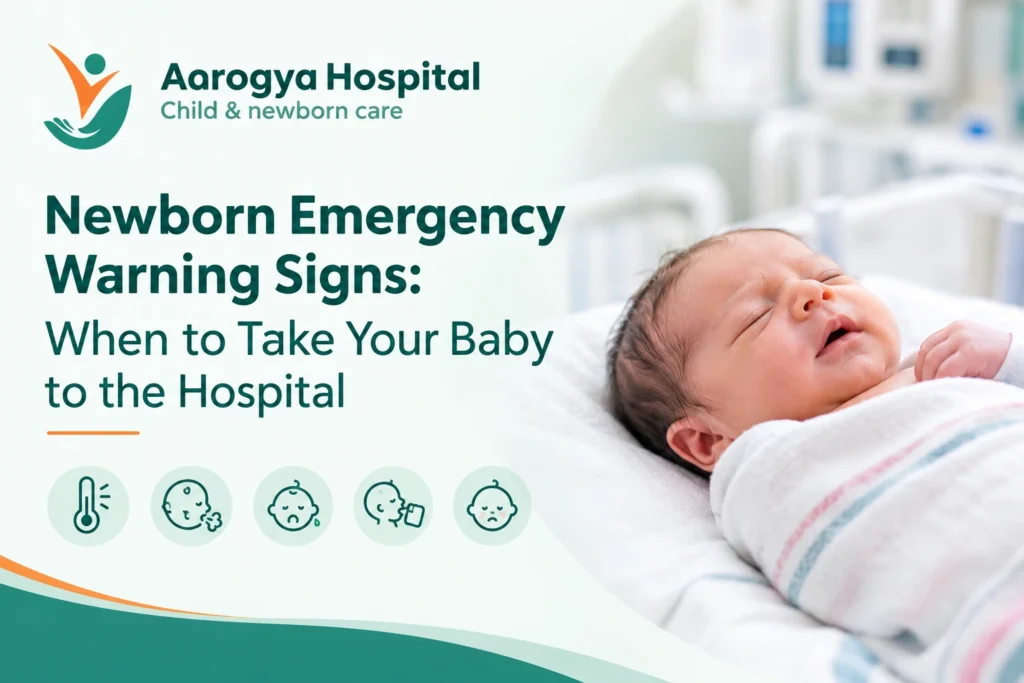
Newborn Emergency Warning Signs: When to Take Your Baby to the Hospital
Aarogya Hospital, Chandigarh — Newborn and NICU Care Near Panchkula and Mohali
Newborn babies need extra care during their first few weeks. They cannot tell us when they feel unwell. Parents must watch for changes in their baby’s breathing, feeding, body temperature, skin colour and movements.
Some health problems can become serious very quickly. Knowing the warning signs can help parents get medical help on time.
If your baby has trouble breathing, blue lips, a seizure or is difficult to wake, seek emergency medical help immediately.
Aarogya Hospital is located in Khudda Lahora, Chandigarh, near PGI Chandigarh. Families from Chandigarh, Panchkula and Mohali can contact the hospital to ask about newborn care and available medical services.
1. Trouble Breathing
Breathing problems can be dangerous for newborn babies. They can start soon after birth or develop later.
Watch for these signs:
- Very fast or difficult breathing.
- Skin pulling in around the ribs while breathing.
- Grunting sounds with each breath.
- Repeated pauses in breathing.
- Blue or grey lips, tongue or skin.
When should you take your baby to the hospital?
Get emergency medical help if your baby struggles to breathe, has repeated pauses in breathing or develops blue or grey lips or tongue.
Do not wait to see if the problem goes away.
2. Fever or Low Body Temperature
Newborn babies cannot control their body temperature well. A temperature that is too high or too low can be a sign of illness or infection.
Watch for these signs:
- A temperature of 38°C (100.4°F) or higher.
- An unusually low body temperature.
- Cold skin along with poor feeding.
- Unusual sleepiness or breathing changes.
When should you take your baby to the hospital?
A temperature of 38°C (100.4°F) or higher in a baby under three months needs urgent medical attention.
A newborn can also have a serious infection without a fever. Do not give fever medicine unless a doctor advises you to do so.
3. Poor Feeding or Refusing Milk
Feeding problems can be an early sign that your baby is unwell. Newborn babies need regular breast milk or formula feeds.
Watch for these signs:
- Refusing milk.
- Drinking much less milk than usual.
- Weak sucking.
- Being too sleepy to feed.
- Repeated vomiting.
- Fewer wet nappies than usual.
When should you take your baby to the hospital?
Contact a doctor promptly if your baby is not feeding well.
If your baby is very weak, difficult to wake or shows signs of dehydration, seek emergency medical care.
Never force your baby to feed if they are struggling to breathe or are not fully awake.
4. Unusual Sleepiness or Less Movement
Newborn babies sleep for many hours each day. However, they should usually wake for feeds and respond to gentle touch.
Watch for these signs:
- Your baby is very difficult to wake.
- Moves much less than usual.
- Baby has a weak cry.
- Feels unusually floppy or weak.
- Your baby does not respond normally to touch or sound.
When should you take your baby to the hospital?
Get emergency medical help if your baby is difficult to wake, does not respond or suddenly stops moving normally.
Do not assume that unusual sleepiness is normal.
5. Yellow Skin or Eyes (Newborn Jaundice)
Jaundice makes a baby’s skin and the whites of their eyes look yellow. It is common in newborn babies, but some cases need treatment.
Watch for these signs:
- Yellow skin or eyes during the first 24 hours after birth.
- Yellow colour that spreads or becomes darker.
- Poor feeding along with yellow skin.
- Unusual sleepiness.
- Dark urine or pale, chalky stools.
When should you take your baby to the hospital?
Yellow skin during the first 24 hours needs urgent medical assessment.
Get medical advice promptly if the yellow colour gets worse or your baby is feeding poorly or sleeping more than usual.
Severe jaundice can harm a baby’s brain if it is not treat. A doctor may check the baby’s bilirubin level. If needed, treatment such as phototherapy may be given.
6. Seizures or Unusual Body Movements
A seizure in a newborn does not always look like strong shaking. It may look like repeated jerking or unusual eye and mouth movements.
Watch for these signs:
- Repeated jerking movements.
- Sudden body stiffness.
- Repeated unusual eye movements.
- Sudden periods of not responding.
- Changes in breathing with unusual movements.
When should you take your baby to the hospital?
A possible seizure in a newborn is a medical emergency. Get emergency medical help immediately.
Keep your baby safe. Do not hold their movements down or put anything in their mouth.
7. Repeated Vomiting or a Swollen Belly
Some babies bring up a little milk after feeding. However, certain types of vomiting can be a sign of a serious problem.
Watch for these signs:
- Green vomit.
- Blood in the vomit.
- Repeated forceful vomiting.
- A swollen or hard belly.
- Vomiting along with poor feeding or unusual sleepiness.
When should you take your baby to the hospital?
Green vomit, blood in the vomit or a swollen belly with other signs of illness needs urgent medical attention.
Do not wait for the vomiting to happen again before seeking help.
8. Signs of Infection in a Newborn
Newborn babies can develop serious infections very quickly. Sometimes, the first signs are not easy to notice.
Watch for these signs:
- Poor feeding.
- Fever or low body temperature.
- Fast or difficult breathing.
- Unusual sleepiness.
- Less movement than usual.
- A weak cry or constant crying.
- Pale, patchy, blue or grey skin.
When should you take your baby to the hospital?
Get urgent medical advice if you think your baby may have an infection.
If your baby has trouble breathing, does not respond or looks seriously ill, seek emergency medical help immediately.
Do not wait for all the signs to appear.
9. Fewer Wet Nappies or Signs of Dehydration
Wet nappies help parents check whether their baby is getting enough milk. The number of wet nappies usually increases during the first few days after birth.
Watch for these signs:
- Fewer wet nappies than expected for your baby’s age.
- A dry mouth.
- Poor feeding.
- Unusual sleepiness or weakness.
- A sunken soft spot on the head.
When should you take your baby to the hospital?
Contact a doctor if your baby has fewer wet nappies than expected.
If your baby is very weak, difficult to wake or has other serious symptoms, seek emergency medical care.
When Should You Take Your Newborn to the Hospital Immediately?
Do not delay medical help if your baby has any of these warning signs:
- Trouble breathing.
- Blue or grey lips or tongue.
- A seizure or sudden loss of response.
- Severe weakness or difficulty waking.
- A temperature of 38°C (100.4°F) or higher in a baby under three months.
- Green vomit or a swollen belly with signs of illness.
- Yellow skin during the first 24 hours after birth.
- A sudden and serious change in your baby’s condition.
If your baby is critically unwell, call your local emergency service. In India, you can call 112 for emergency assistance.
Do not wait for a routine appointment if your baby has serious symptoms.
Why Is Early Medical Care Important for Newborns?
Newborn babies have developing immune systems. This means some illnesses can become serious in a short time.
Early medical care helps doctors find the problem and decide which treatment your baby needs.
Depending on your baby’s condition, the doctor may:
- Check your baby’s temperature and breathing.
- Check the oxygen level.
- Recommend blood tests if an infection is suspect.
- Check the bilirubin level for jaundice.
- Check feeding and fluid levels.
- Provide breathing support or special newborn care if needed.
Not every baby needs intensive care. However, premature babies, babies with low birth weight and babies with serious health problems may need care in a Neonatal Intensive Care Unit (NICU).
Newborn and NICU Care at Aarogya Hospital, Chandigarh
Aarogya Hospital is located in Khudda Lahora, near PGI Chandigarh. It is within reach of families living in Chandigarh and nearby areas, including Panchkula and Mohali.
Parents looking for newborn care near Panchkula or newborn care near Mohali should know where to seek medical help if their baby becomes unwell.
Every baby is different. Treatment depends on the baby’s age, symptoms and overall health.
A doctor can examine your baby and decide whether tests, treatment, observation or special care are need.
Contact Aarogya Hospital to ask about available newborn and NICU services.
If your baby has serious warning signs, seek emergency medical help immediately instead of waiting for an appointment.
Conclusion
Knowing the warning signs of a newborn emergency can help parents act quickly.
Watch for changes in your baby’s breathing, feeding, body temperature, movement and skin colour. Never ignore unusual changes in a newborn’s health.
If you are looking for newborn care in Chandigarh, near Panchkula or Mohali, contact Aarogya Hospital to ask about its available services.
If your baby has trouble breathing, a seizure, blue lips or difficulty waking, get emergency medical help without delay.
Your baby’s health comes first. If something does not seem right, contact a healthcare professional promptly.
Follow Aarogya Hospital on Instagram and Facebook for more information about newborn health and care.
Frequently Asked Questions
What are the first signs that a newborn may be seriously ill?
Poor feeding, trouble breathing, unusual sleepiness, fever, low body temperature and changes in skin colour can be warning signs. Contact a doctor if you notice these changes.
When is a newborn's fever an emergency?
A temperature of 38°C (100.4°F) or higher in a baby under three months needs urgent medical attention. A low temperature with signs of illness also needs prompt medical care.
Is newborn jaundice always dangerous?
No. Mild jaundice is common in newborn babies. However, yellow skin during the first 24 hours, worsening yellow colour, poor feeding or unusual sleepiness needs prompt medical attention.
Where can parents find newborn care in Chandigarh near Panchkula and Mohali?
Parents can contact Aarogya Hospital in Chandigarh to ask about newborn care and available services. If their baby has serious symptoms, they should seek emergency medical help immediately.
Should I wait until morning if my newborn seems unwell at night?
No. Do not wait until morning if your baby has serious warning signs. Newborn babies can become seriously ill quickly and may need immediate medical care.